Sometimes, being the top player at a position on your team is more of a reflection of your team’s lacking talent versus your abilities. That’s certainly the case every year in the NFL. While it’s great to target top options in offenses, sometimes it’s more fruitful to draft secondary targets on good offenses versus primary targets on bad offenses. Let’s take a look at RB2s that are currently being drafted ahead of the last RB1 in 2022 fantasy football rankings (Dameon Pierce).

19 RB2s Drafted Ahead of RB1s
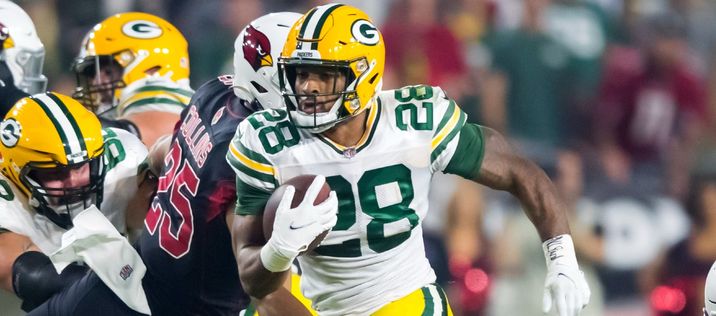
A.J. Dillon started to emerge from his protege’s shadow with 187 rushing attempts, 803 rushing yards, and an RB29 fantasy points per game finish last year. Dillon isn’t the home run threat that Jones is (43rd in breakaway run rate), but he can still punish an opposing defense. He was 17th in yards created per touch in 14th in yards after contact per attempt (minimum 100 carries, per PFF), immediately behind Jones. Unless Jones succumbs to injury, Dillon is likely stuck in a 1B role with a healthy red-zone role.
Kareem Hunt‘s been rumored to be on the trade block this offseason. His contract expires in 2023, and the Browns have a mighty stable of backs behind Nick Chubb including D’Ernest Johnson, Jerome Ford and Demetric Felton.
If no deal is reached by the time the season starts, it would be much less likely that Hunt stays in Cleveland, making him a primed trade target for any team that suffers an injury at running back through training camp/preseason. .
Last year Hunt was limited to just eight games due to a calf injury – but he maintained his effectiveness when healthy through the first six weeks of the season. He was a top-10 running back in PPR averaging 17 fantasy points per game averaging just south of 15 touches per game.
Hunt’s true upside will always be capped in a backfield as the Robin to Chubb’s Batman. But should an injury occur to Chubb or another star running back, Hunt would easily flirt with league-winning upside if he is awarded the requisite volume to do so.
His 6th-ranked yards after contact per attempt (3.54), 6th-ranked yards per route run (1.81) and 26% target rate suggest he’s not slowing down entering age 27-season. All he needs his a change of scenery to recapture his rookie year accolades when he lead the NFL in rushing yards.
Tony Pollard is coming off a career-high in rushing attempts (130) and targets (46). Pollard was one of the most efficient running backs in the NFL. Last season he was fourth in yards after contact per attempt behind only Rashaad Penny, Nick Chubb, and Jonathan Taylor (minimum 100 carries, per PFF). He was also first in yards per route run at the position. Pollard offers stand-alone RB3 production as he was the RB30 in fantasy points per game last season. If anything happens to Ezekiel Elliott, Pollard has league-winning upside.
Gordon is bound to be written off by fantasy draft pundits this offseason due to his age, but he proved that he still has gas in the tank in 2021. The 29-year-old running back was efficient across the board, ranking eighth in both PFF rushing grade (83.4) and forced missed tackles (45) while compiling 231 touches (16th).
With him back on a high-powered offense and with the potential to receive goal-line touches, he could easily become a screaming value in 2022 like James Conner or Leonard Fournette last year.
Even if Walker can carve out a first-year workload similar to that of Chris Carson circa 2020 – 16.4 touches per game, 56% snaps share when healthy – it’s still going to be a massive uphill battle for him to be a fantasy producer in Year 1.
Pete Carroll has a stable of backs including Rashaad Penny, Travis Homer and DeeJay Dallas who all figure to work in at some point despite Walker’s Round 2 draft capital.
Again, even when Carson was the RB1, he was splitting snaps.
Penny was brought back on a one-year deal for $5 million (12tth-highest cap hit), Chris Carson – if healthy – is due $6.1 million (10th-highest cap hit) and Homer/Dallas have routinely worked as pass-catchers out of the backfield.
Seattle also finished dead-last in targets to the RB position last season, creating serious doubt that Walker will be used in that fashion in any capacity as a rookie. Part of that is on Russell Wilson‘s lack of juice in the screen game, but the offense itself doesn’t predicate much RB pass-game usage. Geno Smith posted a meager 12% RB target rate (three per game) in his three starts last season. Drew Lock was at 17%.
The Seahawks have the chance to be a running back by committee and dumpster fire on offense this season for all the reasons I’ve laid out, which is why I am adamantly against paying the premium for Walker. If this team falls behind in games, there’s no telling which RB will even be on the field.
I feel so much better about going with one of the many rookie WRs selected in Round 1 ahead of Walker based on his landing spot.
Hopefully, opportunities should open in this backfield in Year 2 for Walker with Penny likely leaving in free agency. But does he get replaced with another Day 2 running back? Will Seattle’s offense even be efficient in 2023 and beyond? So much uncertainty with this entire situation has me hesitant.
Rhamondre Stevenson experienced a very successful rookie season that should not be overlooked. After fully escaping the Bill Belichick doghouse in Week 9, Stevenson earned top grades across the board.
He was PFF’s third-highest graded running back (84.2). Stevenson also ranked 13th in rushing yards and in yards per route run (1.41). For fantasy, the rookie running back was the RB25 in total points scored, eight spots behind his backfield teammate Harris.
There’s a high ceiling for Stevenson, especially if you ask former Patriots linebacker Rob Ninkovich. The ESPN analyst went as far as saying that Stevenson “…will be one of the better, if not one of the top three, running backs in the league based on what I saw with his strength, explosion and catch-and-run ability.”
RIP Michael Carter RB1 szn. The Jets drafted workhorse running back Breece Hall at the top of the 2nd round, but even considered trading up for him in Round 1 before selecting him 36th overall. The draft capital shows New York’s commitment towards Hall being their clear-cut RB1 for 2022 and beyond, which makes Carter nothing more than a hand-cuff. It’s a reminder to always sell high on Day 3 running backs that flash as rookies; they can be easily replaced and likely won’t “survive” draft after draft without investment from their team.
Carter’s looking anywhere between five-to-eight touches per game with Hall entrenched as the bellcow, making the former UNC back near obsolete as anything other than a backup with some upside.
From Weeks 7-9 with Tevin Coleman sidelined, Carter averaged 19 touches per game and a 66% snap share. He also finished 10th in yards after contact per attempt (3.4) and third in PFF’s elusive rating.
Carter’s receiving ability also fueled four top-17 weekly finishes in 2021, three of which were inside the top-13 in games that featured quarterback check-down king Mike White under center.
Rookie running back James Cook has immediate sleeper fantasy appeal across all PPR formats based on his second-round draft capital, pass-catching prowess, explosiveness and offensive situation. The 5-foot-11, 199-pound running back has more than enough heft to manage a decent workload especially as a receiver out of the backfield. The 5-foot-7, 203-pound Devin Singletary was the RB3 over the last six weeks of the regular season when the Bills entrenched him as the featured guy. Cook with an ECR of RB44 seems priced closer to their floor than his ceiling considering Round 2 running backs have finished as top-36 running backs more than half the time (55%) since 2013.
The Kansas City Chiefs signed running back Ronald Jones to a one-year deal to help bolster their running back room behind Clyde Edwards-Helaire.
The former Buccaneer took a major step backward in 2021, being regulated to strict backup duties after losing out on the starting gig in Tampa Bay to Leonard Fournette. And even when loaded to take on the bell-cow role with Fournette sidelined during the end of the season, RoJo failed to fire.
He earned 20 carries in Week 16 versus the Panthers but totaled just 65 yards. The plodding runner also finished 51st out of 64 qualifying running backs in yards after contact per attempt (2.5).
Jones is a one-dimensional grinder back, whose fantasy value will be super reliant on carry-volume, offensive line play, and overall offensive efficiency.
That in itself means he will have fantasy appeal as a late-round running back in redraft if he can carve out a role on early-down and/or at the goal-line in a high-powered Chiefs offense.
Alexander Mattison has played out of his mind when given the opportunity with Dalvin Cook sidelined. In the four games since 2020 with 60% or higher snap counts, he’s averaged 23.5 rushing attempts with 148.2 total yards per game. In that quartet of games, he was the RB7, RB6, RB8, and RB4 in weekly scoring. Assuming Kevin O’Connell doesn’t upset the order of things or Ty Chandler or Kene Nwangwu don’t hop him on the depth chart, Mattison is primed to remain one of the top handcuff options in fantasy.
Through the first 12 weeks of the 2021 season, Darrell Henderson was functioning as a fringe RB1 in all scoring formats. He ranked as the RB13 overall and RB16 in fantasy points per game (14.3) in half-point scoring, operating as Sean McVay’s bellcow back with Cam Akers sidelined due to injury.
Los Angeles would likely turn to Hendo as their pseudo-workhorse if Akers suffers another injury in 2022. And he’s likely to be productive based on this projected three-down volume and beneficial offensive environment.
Just be wary that Henderson may not offer the tantalizing league-winning upside based on his own inability to stay healthy throughout his NFL career. He’s never started more than 11 games in a season and is already dealing with a soft tissue injury in OTAs.
James Robinson operated as the pseudo bellcow for the Jacksonville Jaguars in 2021 after Travis Etienne went down with a preseason injury. He posted inconsistent fantasy production as the RB24 overall and in points per game in 14 games amid horrible usage deployed by the 2021 Jags coaching staff.
His touches varied from 21-to-2 depending on the week, so he was nearly impossible to project in fantasy. It’s possible that 2022 presents a similar issue with Robinson as Etienne makes his professional debut.
But JRob does deserve credit for maintaining efficient play whenever he got opportunities last season, finishing 11th in yards after contact per attempt (3.3) and 8th in red-zone touchdowns (8).
His real hurdle for fantasy relevance besides fending off a 2022 first-round running back is attempting a speedy recovery from a torn Achilles suffered in late December. He will be unable to participate in OTAs, while his backfield counterpart is full-go as the team installs the new-look Doug Pederson offense. The former undrafted free agent is not guaranteed to be ready for Week 1.
It’s hard to envision Robinson being anything more than a speculative zero-RB target, with hopes that he can recapture 2020 form if given the volume. However, Pederson’s track record of deploying a multitude of backs does make it seem like Robinson will be a 1B to Etienne’s 1A, with his clearest path to fantasy relevance coming through goal-line opportunities.
Nyheim Hines posted career lows across the receiving board in 2021, but there’s hope that with a new quarterback under center that he can bounce back in 2022.
No passer targeted running backs more than new Colts quarterback Matt Ryan did in 2021 – 8.6 targets per game. Bodes well for Hines to provide more usable weeks like he did in 2020. That year, Hines finished as RB18 in PPR scoring.
Raheem Mostert will also be 30 years old by the season’s start. He has played 16 games once and never started more than 8 games in a season.
In fantasy, J.D. McKissic has stacked back-to-back seasons of top 36 running back production (RB25, RB28). The Commanders are hell-bent on capping Antonio Gibson‘s ceiling, but you can’t fault them because McKissic remains one of the best receiving backs in the NFL. Last season he ranked fourth in target share and yards per route run among running backs. McKissic could see a hit to his raw volume and touchdown expectations (which were already low) if Brian Robinson gets involved on early downs and even a smidge in the passing game. Because of this, McKissic is best viewed as an RB4 with some upside.
The Chargers are no strangers to taking shots on bigger but unathletic running backs on Day 3 of the NFL Draft. Joshua Kelley was the guy in 2020 and Larry Rountree was the guy in 2021.
Isaiah Spiller represents the latest rehash of the Chargers trying to find an appropriate thunder to Austin Ekeler‘s lightning, and I for one think Spiller is already the best bet currently on the roster. The former Texas A&M running back has the capacity for three-down spot start duties with an all-encompassing skill set and desirable size – 6-feet and 217 pounds .
Spiller should be a solid producer for the Chargers if given the opportunity although his lack of top-notch speed could keep him from being elite. He had only eight carries of 20-plus yards in 2021.
But I’d be hard-pressed to ignore his impressive age-adjusted production as one of his most encouraging traits. Since Day 1 at Texas A&M, Spiller has been the lead dog for the Aggies.
As a true freshman in 2019, he scored 10 rushing touchdowns and finished 16th in the nation in yards after contact per attempt en route to a 22% dominator rating.
The power running back capped off his first year in impressive fashion with back-to-back seasons of 1,000 rushing yards and 100 missed tackles. Spiller also displayed receiving prowess, commanding at least an 8% target share and an average of 25 receptions per season.
With Justin Jackson still an unsigned free agent, Spiller looks slated for instant impact in Year 1.
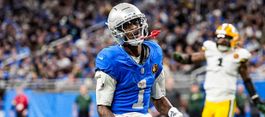
Last season in the early going, Jamaal Williams was the understudy to D’Andre Swift, which is a role he will reprise this season. In Weeks 1-7, he averaged 12.4 touches and 58.7 total yards per game playing 29-49% of snaps per game. He was the RB37 in fantasy points per game. When Swift was out and Williams was active, he played 42-47% of snaps with 18 rushing attempts and 74 rushing yards per game. Williams isn’t the sexiest handcuff or late-round selection, but the Lions’ offense should take another step forward this year, and Williams will be the primary back if Swift were to miss time again.
Taking a flier on Kenneth Gainwell is a bet on his pass-catching chops in the Eagles offense. The Memphis product finished sixth in yards per route run, hauling in 38 of his 50 targets for 302 receiving yards. And in 5 games where he played at least 35% of the snaps, Gainwell averaged 17.5 fantasy points (PPR) and 4.2 catches per game on just 12.4 touches per contest.
Among the Eagles’ crowded backfield, Gainwell playing on third downs as the primary pass-catcher provide him weekly standalone value. But there’s always a chance he eats more into work on early downs and in the red zone entering Year 2.
The team’s leader in red-zone touches from last season (Jordan Howard, 24) is no longer on the roster. Gainwell scored five touchdowns from inside the 20-yard line last season.
Gus Edwards is a true underdog story – a former undrafted free agent who owns a top-5 PFF rushing grade and yards per carry (5.1) since 2018. But with coming off a torn ACL and J.K. Dobbins entrenched as the 1A starter in the Ravens backfield, is the efficient GusBu even worth the squeezer in fantasy football?
Consider in his best season, 2021, Edwards finished RB35 in 0.5 PPR scoring. That low-end RB3 upside is gone now. He can’t be viewed as much of anything but a hand-cuff to Dobbins, with hopes that he can also occasionally find the end zone to make up for a lack of pass-game work. Because ten touches per game in the form of carries is going to do literally nothing to help your fantasy lineup. Do not buy into the fallacy that Edwards owns “stand-alone value.”
2022 Fantasy Football Running Back Rankings

Subscribe: Apple Podcasts | Spotify | Google Podcasts | Stitcher | SoundCloud | iHeartRadio
If you want to dive deeper into fantasy football, be sure to check out our award-winning slate of Fantasy Football Tools as you navigate your season. From our Start/Sit Assistant – which provides your optimal lineup based on accurate consensus projections – to our Trade Analyzer – which allows you to instantly find out if a trade offer benefits you or your opponent – we’ve got you covered this fantasy football season.