Sometimes, being the top player at a position on your team is more of a reflection of your team’s lacking talent versus your abilities. That’s certainly the case every year in the NFL, specifically at the wide receiver position. While it’s great to target top options in offenses, sometimes it’s more fruitful to draft secondary targets on good offenses versus primary targets on bad offenses. Let’s take a look at WR2s that are currently being drafted ahead of the last WR1 in 2022 fantasy football rankings (Jakobi Meyers).

18 WR2s Drafted Ahead of WR1s
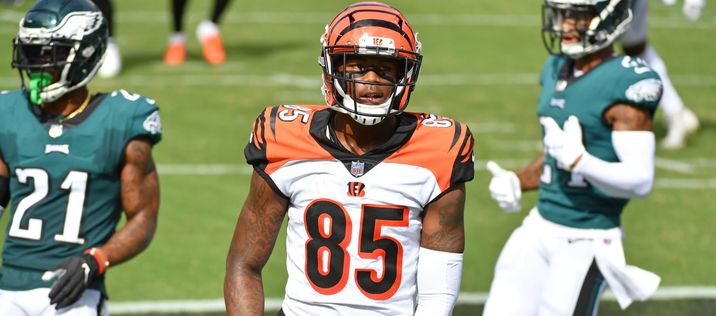
Tee Higgins‘ 23% target rate per route run was higher than Ja’Marr Chase‘s 21% during the 2021 regular season as was his 25% target share in the games they played together when healthy.
There’s no denying that WR1 overall upside exists with Chase in 2022, but Higgins’ constant command of targets in a loaded Cincinnati offense will make him a screaming value in 2022 fantasy drafts.
Jaylen Waddle looked primed to make the leap into the top-12 conversation after a stellar rookie season. Along with breaking Anquan Boldin’s rookie reception record, Waddle commanded a 22% target share and 24% target rate per route run – 18th-best in the NFL.
But with the expensive addition of veteran Tyreek Hill, it is less likely that Waddle is the clear-cut No. 1 receiver in Miami. Hill is coming off a season where he commanded the league’s seventh-highest target rate per route run (27%). The trade moves Waddle down from a fringe WR1 to mid-range fantasy WR2 after seeing almost zero target competition last season.
Mike Williams had the opportunity to take his talents elsewhere this offseason in free agency, but decided to stay in Los Angeles with quarterback Justin Herbert. Hard to argue with the choice to sign a three-year deal worth $60M attached to a young superstar quarterback, especially when that quarterback fueled a career year.
He stormed out the gate in 2021 as the WR2 in fantasy through the first five weeks of the season, averaging 94.2 receiving yards and 1.2 receiving touchdowns per game.
Big Mike finished the season as the WR23 in fantasy points per game despite cooling off considerably in the later weeks in addition to leaving a boatload of touchdown production on the table.
He finished sixth in end-zone targets (16) but caught only five for touchdowns.
With positive TD regression on his side, Williams looks like a sneaky candidate to repeat his WR12 overall finish in the half-point scoring format.
Entering Year 3, Jerry Jeudy finally has a quarterback who can take full advantage of his ability to separate from defenders – 96th percentile separation percentage in 2021 – with Russell Wilson taking the reins.
With Courtland Sutton and Tim Patrick operating from the outside, Jeudy figures to become Wilson’s go-to target in the slot unless K.J. Hamler pushes him out. Jeudy’s efficiency metrics should also see a massive boost now that he’s catching passes from a future Hall-of-Fame quarterback, but it remains to be seen if Jeudy will play an ancillary role as a red-zone threat.
Upgrading from Drew Lock and Teddy Bridgewater to Wilson is great for Jeudy, but we have to remember that he is still an unproven fantasy commodity. Great route-running and separation skills aside, he hasn’t scored many fantasy points the last two seasons.
And that’s not the case with every Denver receiver, because Patrick’s production last two seasons earned him a three-year, $34.5 million contract extension.
Even so, Jeudy should easily experience his best NFL season to date in 2022, but it may not be as great as some die-hard Jeudy stans would care to admit. There are a lot of weapons in Denver, and predicting Wilson’s best option on a week-to-week basis was often a challenge when it was only between DK Metcalf and Tyler Lockett.
As with those Seahawks receivers, there are going to be inconsistent weeks from Jeudy. And his lack of red-zone usage makes him more susceptible to bust games without having a touchdown opportunity to fall back on.
Before Robert Woods hit the IR, he was the WR17 in half-PPR scoring per game. Van Jefferson saw elite usage playing on every down as the No. 3 receiver but didn’t follow up his playing time with any worthwhile production. Jefferson was WR35 overall on the season and outside the top 40 in points per game despite a top-tier 86% route participation.
The likely scenario for Allen Robinson is that he steps up into the No. 2 role behind Cooper Kupp and operates the way Woods started the year and/or by how Odell Beckham Jr. ended the season.
Down the playoff stretch, Beckham Jr. averaged a 19% target share and 12.4 fantasy points per game from Week 12 through the divisional round (fantasy WR2).
Chris Godwin posted another stellar season last year as the WR7 in fantasy football. He set opposing defenses on fire as Tom Brady‘s underneath weapon, ranking eighth in YAC per reception and fifth in overall YAC yardage. The biggest question for Godwin in 2022 isn’t talent but his recovery from an ACL and MCL tear sustained in Week 15 of last season. If Godwin is good to go, he’s a top 15 fantasy wideout, but tempering expectations early on if he’s limited or starts on the PUP pushes him into WR2/WR3 territory based on possible time missed.
Gabriel Davis averaged 19.8 fantasy points per game (PPR) and 16.0 expected fantasy points per game in his last six games while running a route on 88% of dropbacks as the Bills finally emphasized his playing time in the offense.
As a strong bet to earn the No. 2 wide receiver job come opening day, Davis has a legitimate shot to be a reliable fantasy option in a Josh Allen-led offense in 2022.
The 32-year-old wideout has made his hay in fantasy because of his “ability” to find the end zone 24 times since the start of 2020, but it’s something that just isn’t sustainable in the long term. Based on Thielen’s targets and yardage totals, his total TD number should be closer to 16.
Justin Jefferson is an ascending rocketship that will only see his TDs rise entering Year 3, most likely coming at the detriment of Thielen. Not to mention, AT’s age may finally be catching up to him after he posted his lowest PFF receiving grade and yards per route run since he first became a starter back in 2016.
DeVonta Smith didn’t have the record-breaking rookie seasons like Ja’Marr Chase or Jaylen Waddle, but he was still extremely solid. He finished 10th in overall team air yards share and top-20 in PFF receiving grade among WRs with at least 100 targets.
So Smith’s WR29 finish and WR42 standing in points per game hardly does the rookie justice while playing in a run-heavy offensive attack. From Week 7 onward, Smith never saw more than six targets in any game.
I don’t necessarily believe that Smith’s targets per game will increase substantially after the team added A.J. Brown this offseason; that puts Smith firmly in the fantasy WR3 tier.
I can’t cultivate a likely scenario where the Seattle Seahawks wide receiver accrues any type of worthwhile fantasy value in 2021.
He is turning 30 years old this season and finds him in a situation with Geno Smith/Drew Lock at quarterback. Lockett’s infamous for his roller-coaster production – four top-5 finishes, seven outside the top-36 in 2021 – and I expect no less based on his current situation in 2022. The major difference is the bad games will be more frequent than ever with the massive QB downgrade.
Lockett averaged just 9.0 fantasy points per game (47th) without Wilson last season.
With Lockett competing for targets alongside Metcalf in a run-heavy offense, he looks like a straight-up fade unless his ADP falls dramatically.
There’s really not much left to say when it comes to Hunter Renfrow. The kid’s a certified stud and doesn’t get the respect he deserves. The Raiders slot receiver hung a WR13 overall finish last season due to a spectacular late-season surge.
He went over 100 receiving yards in three straight games (Weeks 12-14) while maintaining a 25% target share.
From Week 12 onward, his production generated a WR8 standing in half-point scoring.
Renfrow made the most of the opportunities he got in 2021, and that won’t change in 2022. Adding Davante Adams and Darren Waller will make targets for Renfrow harder to come by, but stay rest assured that the shifty wideout will perform if either guy is forced to miss time.
DeAndre Hopkins wasn’t completely washed last season, but his days as an elite alpha wide receiver could be over. Last season he was the WR21 in fantasy points per game as he logged his first season since 2017 outside the top 20 in targets per snap. Hopkins only commanded a 20.5% target share which was good for 35th among wideouts. While the suspension should ensure that Hopkins will return fully healthy, it’s not a sure thing that we don’t see his numbers decline further in 2022. He ranked 31st in yards per route run last season (minimum 50 targets, per PFF).
Fantasy managers are still trying to figure out what went wrong with Brandon Aiyuk during the first half of last season. He was hyped up after an impressive rookie campaign but suffered a hamstring injury during training camp that made him unreliable in the starting offense. Through Weeks 1-7, Aiyuk had just one weekly finish inside the top-25. He also averaged an abysmal 0.63 yards per route run – a mark that ranked 98th out of 102 qualifying WRs. Woof.
But give credit to Aiyuk for turning his season around during the second half. His yards per route run increased substantially (2.16, 13th) and he averaged 13.1 PPR fantasy points per game as the WR24.
If Aiyuk can roll over his second-half production into 2022, he could end up as a smashing fantasy value in a similar way that Deebo Samuel was viewed in 2021.
Robert Woods was traded to the Titans after the Rams signed Allen Robinson in free agency. The move was less about Woods’ ability, but rather his salary cap hit that the Rams were looking to free themselves from.
Still, entering his age 30-season fantasy managers should question whether Woods has the juice left to continue producing for fantasy. Often viewed as a safe fantasy WR2 during his time in L.A. – he was WR17 before his injury in 2021 – Woods might be subject to some poor game conditions in the Titans’ run-heavy approach that could nuke his weekly fantasy appeal.
He’s got a chance to be the No. 1 receiver if rookie Treylon Burks fails to hit the ground running, but anything less will not be fruitful for the seasoned veteran.
Over the past two seasons, production has not been kind to WRs over 30 years old. Only three receivers over 30 – Cole Beasley, Adam Thielen, and Marvin Jones Jr. – finished as top-40 fantasy options. If he stays healthy, Woods could easily beat his ADP.
But I’m just not sure how high his fantasy ceiling is based on the situation.
Chase Claypool‘s second-year breakout was inevitably halted by Ben Roethlisberger’s lack of downfield throwing ability: On throws with 20-plus air yards, Big Ben graded 31st out of 38 qualifying QBs.
Claypool commanded a 27% air yards share on the season and led the team in the metric over the final four weeks. Better days should be ahead of the Notre Dame product if Pittsburgh can get better downfield quarterback play from Kenny Pickett/Mitchell Trubisky.
Claypool is also due for positive touchdown regression after catching just one of his 12 end-zone targets last season. The 6-foot-5 monster is no stranger to hitting paydirt, after being one of eight wide receivers to score double-digit touchdowns as rookies since 1998.
However, Claypool’s range of outcomes is quite wide heading into his third season with 2022 second-round pick George Pickens, chomping at the bit to be the No. 2 on the offense behind Diontae Johnson.
After enjoying a breakout sophomore campaign in 2020 that saw Garrett Wilson earn a 34% dominator rating – which considers the number of touchdowns and receiving yards a player commands within their offense – at 20 years old, the Ohio State product ran it back in impressive fashion in 2021.
The Buckeye scored 12 receiving touchdowns, compiled over 1,000 receiving yards and generated the FBS’ 12th-highest passer rating when targeted (141.7).
He also proved to NFL teams that he was more than just a shifty slot receiver, averaging 3.00 yards per route run despite operating on the outside on 83% of his routes run, which nearly matched his same yards per route run average from 2020 when he spent most of his time inside.
And although Wilson’s 2021 24% dominator rating was less than his sophomore campaign, that’s really due to Ohio State’s talent in the wide receiver room. He was competing for targets with senior Chris Olave and sophomore standout Jaxon Smith-Njigba, who led the nation in PFF receiving grade (91.7).
Going beyond the box score reveals that Wilson is a versatile route runner who can align anywhere on the field and still win.
He was selected by the New York Jets 10th overall and joins a somewhat crowded WR room. And nobody can be sure Zach Wilson can support one or multiple fantasy assets. There are definitely question marks.
However, Wilson is worth betting on because he’s shown the ability at Ohio State to command targets and produce in an offense littered with other elite talents. Doesn’t hurt his chance that he was deemed open on 84% of his targets last season.
Michael Gallup‘s late-season injury will almost certainly hurt his chances of being available for Week 1, with some diagnoses saying the Cowboys’ WR won’t be ready until October.
The 2018 third-rounder averaged just 10.2 fantasy points per game in 2021 (47th), less than his 2020 season (10.8).
It \doesn’t help Gallup’s case either that the team re-signed tight end Dalton Schultz, who figures to compete for top targets with CeeDee Lamb. Third-round rookie Jalen Tolbert also figures to get plenty of reps in training camp with Gallup rehabbing.
Be careful to not overinvest in Gallup for fear that you’ll be wasting a roster spot for a player that falls into the fantasy WR3 with upside tier, that just doesn’t move the needle.
Even with Michael Thomas presumably back in the fold, there was still a gaping hole at the wide receiver position in the Big Easy. Long-time general manager Mickey Loomis has had zero issues spending high-end draft capital on WRs in the past, so it’s not surprising the Saints traded up to draft Chris Olave at No. 11.
The former Buckeye doesn’t offer the same skill set as Thomas, but he can separate from defenders at an elite level downfield. Olave wrapped up his 2021 season in the 96th percentile in separation versus single coverage and caught seven touchdowns on throws of 20-plus air yards.
Olave draws parallels to Calvin Ridley with his impressive route running ability. But like Ridley coming out of school, Olave doesn’t offer much after the catch.
His forced broken and missed tackle rate ranked 43rd among 43 qualifying wide receivers in the class. His yards after the catch per reception (4.2) ranked 37th.
Without much YAC-ability in an offense that ranked fifth in that YAC/reception last season and a firm seat in the WR2 chair behind a healthy Thomas, I have trouble getting overly excited for Olave in New Orleans as nothing more than a boom-or-bust WR4.
2022 Fantasy Football Wide Receiver Rankings

Subscribe: Apple Podcasts | Spotify | Google Podcasts | Stitcher | SoundCloud | iHeartRadio
If you want to dive deeper into fantasy football, be sure to check out our award-winning slate of Fantasy Football Tools as you navigate your season. From our Start/Sit Assistant – which provides your optimal lineup based on accurate consensus projections – to our Trade Analyzer – which allows you to instantly find out if a trade offer benefits you or your opponent – we’ve got you covered this fantasy football season.