
It’s been a couple of months since we last checked in on our dynasty trade value chart and there have been a ton of dramatic developments that have greatly altered the dynasty landscape . . .
Ok, that’s not true. Sure, Christian Yelich is now on the Brewers and Yu Darvish is now on the Cubs, but over the course of a career, those changes do not move the needle that much (yet) for dynasty purposes. Still, even without any baseball action, there’s been plenty of time to recalibrate our dynasty values. So, let’s take a gander at where things stand now as we approach Spring Training.
Just a reminder: The values below do not represent auction dollars or FAAB. They’re simply a way to evaluate potential trades in a vacuum.
Complete a mock draft in minutes with our free Draft Simulator 
As you can see there’s plenty of movement throughout the trade values, but the majority of it is simply a product of taking a closer look at the values and my dynasty rankings. Essentially, any movement of three spots or less should not be considered significant at this stage. For the most part, it’s simply a factor of updating a player’s projections for this coming season and a reassessment of his long-term value. There’s a lot of tweaking that goes on throughout the offseason, and dynasty trade values are no exception.
There are, however, some players who made major moves in the values, so let’s discuss the circumstances.
The Projection Movers
There are a handful of players who have gained or lost a significant amount in trade value simply because my projections for the upcoming season have changed, or because I’ve taken a closer look at their recent performance and determined that it appears to be more sustainable that I thought.
Jose Ramirez and Tommy Pham are two examples of players whose long-term value I’m more bullish on after taking a deep dive into their 2017 numbers. The 2017 version of Ramirez looked like largely the same as the 2016 version except for a massive jump in power (29 home runs and 56 doubles in 2017 versus 11 home runs and 46 doubles in 2017). And yes, the “juiced balls” undoubtedly made a difference, but a closer look at the numbers shows that Ramirez’s power gains were due largely to a change in approach. Ramirez upped his pull percentage to 46.3% (18th-best in the league), his hard-hit rate to 34%, and his fly-ball percentage to 39.7%. In other words, Ramirez made a conscious effort to pull the ball and hit the ball in the air more, which led to a .265 ISO, just below Paul Goldschmidt. That approach, as much as the likelihood that the balls were juiced, suggests that Ramirez’s long-term outlook may be more in line with his 2017 numbers than his previous performances.
As for Pham, his shocking 2017 numbers certainly came out of nowhere, but there’s a narrative that makes it seem plausible that his performance was for real. Pham complained of vision problems in previous seasons which apparently affected his depth perception, and his strikeout rate dropped from 38.8% in 2016 to 22.1% in 2017, a number that continued to decrease as the season went on. He also got consistent playing time for the first time in his career and is one of the more analytically-minded players in the entire game. He’s a bit older than we’d like from our dynasty-league stalwarts (he’s entering his age-30 season), but there’s certainly more there to support long-term success from Pham that I had originally suspected.
Other significant movers include Shohei Ohtani, who gains 32 points in trade value from our previous post, and Michael Conforto, who takes a rather large dive. Ohtani wasn’t in the player pool as of the last update, so he was not included on our dynasty trade value chart. Seriously. That’s the whole explanation. But long-term, he should be valued on par with Noah Syndergaard and Madison Bumgarner.
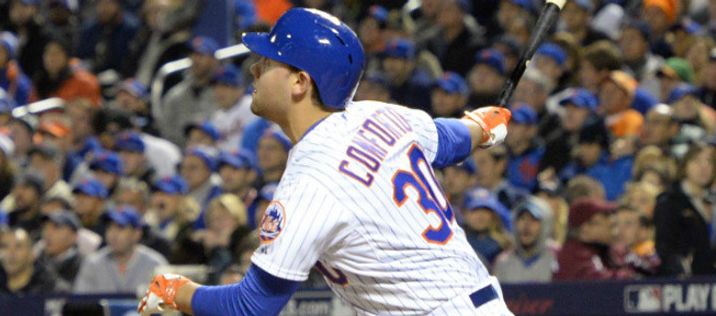
As for Conforto, rosier projections about his return from the torn posterious capsule in his left shoulder injury have abated, and he’s now looking at a best-case scenario of May 1st. Shoulder injuries, though they affect pitchers more often, are notoriously unpredictable and it’s fair to have question marks about how the injury will affect Conforto’s career. In the immediate future, however, when your best-case scenario is five months of the season, and you play for a Mets team for which best-case scenarios are never met, you’re going to take a downgrade in trade value.
The Prospect Movers
Almost all of the other significant movers are prospects. As we discussed in the first article discussing trade values, I believe the greatest amount of emphasis should be put on immediate impact (i.e., 2018) with future seasons taking a lesser, though still important, role. But there are enough prospects out there who either look ready to make an impact earlier than expected or appear to be entering into the can’t-miss category.
Vladimir Guerrero Jr. is still a couple of seasons away from making an impact in the major leagues, but there’s little doubt that he will. He had a .450 OBP in High-A last year and has walked more than he has struck out in the minors. He should eventually develop into a monstrous power hitter, and there’s little doubt of an eventual significant fantasy impact. The fact he won’t see the majors for at least a year (and likely more) keeps his value in check, but it’s certainly going to rise further.
Eloy Jimenez got a cup of coffee in Double-A with the White Sox and was far from overmatched, slashing .353/.397/.559 over 18 games. Jimenez’s ability to make contact and his developing patience at the plate shows why he has been one of the top prospects in the game for at least the last year. With the possibility of a September callup and an almost guaranteed impact in 2019, Jimenez moves up.
Finally, Nick Senzel, who has been outstanding at every minor league level for the Reds, has the best chance of the above-mentioned prospects of making an impact in 2018. Senzel lacks the upside of Guerrero and Jimenez, but his overall line in the minors (.315/.393/.514) shows that he has the tools to be a strong everyday player. Currently blocked by Eugenio Suarez at third base, the Reds will surely want to take a look at their third baseman of the future at some point soon, and he should see the majors this season and make an immediate impact.
Happy trading!
Subscribe: iTunes | Stitcher | SoundCloud | TuneIn | Google Play
Dan Harris is a featured writer for FantasyPros. For more from Dan, check out his archive or follow him on Twitter at @danharris80.
