First, a mea culpa. This article should have dropped last month but WordPress acted up on me and I lost a great deal of information so I had to redo it. Still, I believe you will find the information helpful as you look at your process from this past year while also preparing for next year.
Everything we look at for fantasy purposes deals with volume. Running backs often pop from out of nowhere because they inherit a 15+ touch role. The same goes for receivers, as targets equal production. We also factor in other measures like air yards and aDOT, two of the top efficiency metrics to determine what receivers are doing with their target share. We can also isolate situations for fantasy reasons where there is a narrow distribution of targets so we get a “bankable workload.” There are players like Cooper Kupp (WR – LAR) and Stefon Diggs (WR – BUF) who are established target hogs – but everyone knows who those players are. What we are looking for is a guy like Jakobi Meyers (WR – NE), who was 20th in targets but finished as the WR38 due to a lack of yards and touchdowns. He should be set up for a much better finish next season and is flying under the radar. Mining for those types that we can nab in the middle rounds of drafts will help set us apart next summer.
One other note: As the NFL moves towards a more pass-heavy league, there were only five teams in the NFL this season that didn’t have a receiver who had at least 100 targets: Cleveland, Denver, New Orleans, and both New York teams. These teams are extreme outliers, as even the team with the 2nd most rushing attempts in football (Philadelphia) had a receiver with 100+ targets on the season. On the other end of that spectrum, Dallas was the lone team this year to support three receivers with 100 or more targets (CeeDee Lamb (WR – DAL), Amari Cooper (WR – DAL), Dalton Schultz (TE – DAL)).
Analyze any potential deal with our Trade Analyzer 
The Arizona Cardinals offense took a big step back in 2021. Injuries to Kyler Murray (QB – ARI) and DeAndre Hopkins (WR – ARI) forced the Cardinals to place more emphasis on the running game, but also showed that Arizona needs to find a bonafide No. 2 option in the passing game. Christian Kirk (WR – ARI) had a nice season (77/982/5) but he isn’t able to command attention in the secondary the way Hopkins does. Enter Zach Ertz (TE – ARI), who was acquired in October from the Eagles for a fifth-round pick. Ertz ended up leading the Cardinals with 7.4 targets per game as he settled into a role as an every-down player. With Ertz and Kirk both set to be free agents, Arizona has some tough decisions to make this offseason.
Hopkins had a 29.4% target share in 2020, a massive number that made him one of the most targeted receivers in football. This year, however, he was on pace for roughly 140 targets prior to his season-ending injury. He was averaging right around four receptions per game as well, numbers that would have been among his career-worst. Hopkins turns 30 in June and carries an enormous cap number the next three seasons. For Murray to be a top-5 QB, they will need Hopkins to get back to his 2020 form. After the way he looked in the Wild Card round, it’s obvious he needs a healthy Hopkins to do just that.
Where do we begin with the Falcons? The good news is that Kyle Pitts (TE - ATL) led them in targets and, despite what most of the dynasty community would lead you to believe, had a strong season. Pitts finished fifth among tight ends in targets and he should be a post-hype breakout player in 2022. The other bit of good news was the play of Cordarrelle Patterson (RB/WR - ATL), who was finally unleashed in Atlanta. He had career highs in receptions, receiving yards, rushing yards, and touchdowns as he was a PPR dynamo with dual position eligibility on most platforms.
Things weren't as rosy for the receivers corps in Atlanta, as Russell Gage (WR - ATL) led the position in targets with 93. With Calvin Ridley (WR - ATL) stepping away from football to focus on his mental health, the Falcons were forced to lean on Gage and Olamide Zaccheaus (WR - ATL). Matt Ryan (QB - ATL) struggled, failing to reach 4,000 yards passing for the first time since 2010. Gage and Zaccheaus are nice players - Gage in particular would make a fine WR2 on most teams - but asking them to headline the receiver room is a recipe for disaster. There is speculation that Ridley has played his last down in Atlanta. If that's true, the Falcons will need to upgrade the receiver position heading into next season to help Ryan try and regain his form.
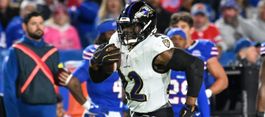
The Ravens have been a run-heavy outfit in recent seasons but this year they ranked 9th in the NFL in pass attempts per game. The narrow distribution in targets led to Mark Andrews (TE - BAL) and Marquise Brown (WR - BAL) combining for almost a 50% target share between them. Andrews had a breakout season, establishing himself as one of the elite tight ends in the game. He finished with a whopping 153 targets, good for eighth in the league and tops among tight ends. Andrews was the clear No. 1 target for the Ravens when they were in tight spots and, at just 26 years old, should be in consideration as the TE1 in redraft and dynasty leagues moving forward.
As for Brown, his 146 targets ranked him right behind Andrews and ahead of guys like Ja'Marr Chase (WR - CIN), Travis Kelce (TE - KC), and Jaylen Waddle (WR - MIA). Brown finished with a somewhat quiet 91/1008/6 line and if it feels like he left a lot of meat on the bone, you'd be correct. He had a couple of huge drops in Week 3 against Detroit that would have resulted in touchdowns and likely vaulted him into WR1 territory on the season. I'm less optimistic that Brown can duplicate his 2021 season than Andrews due mostly to the emergence of Rashod Bateman (WR - BAL) in 2022. Bateman's 11% target share is sure to grow next season, making him a nice value in drafts at what will almost assuredly be an ADP outside of the top-100.
For the second year in a row, Stefon Diggs dominated looks in Buffalo, finishing fifth in the NFL in targets. He finished with fewer catches and yards than he did in his monster 2021 season, but regression was almost certain to hit. I hesitate to say I have some concerns because Diggs was still a back-end WR1, but for an elite receiver with such impressive volume, we have come to expect more. If I told you last summer that Josh Allen (QB - BUF) would have a career-high 646 pass attempts this year, Diggs' stock would have gone to the moon. However, he only posted two 100-yard games this season and he had seven games with 60 yards or less, making him somewhat uneven from week to week. He did score more touchdowns this year (1o) which saved a few weeks where he had paltry catch and yardage totals (Week 11 against the Colts he went 4/23/2). I'd expect Diggs to continue to be a target hog, but with more efficiency, he will vault back to being a top-5 WR.
Cole Beasley (WR - BUF) had the second most targets for the Bills, but he had almost as many weeks with four or fewer targets (6) as he did with 10 or more (5). The Bills are up against the cap a bit and cutting Beasley - who will be 33 at the start of next season - makes some sense. If he isn't back with the team, his 112 targets would most likely be soaked up by Gabriel Davis (WR - BUF). The other piece of this passing game I love moving forward is Dawson Knox (TE - BUF). He doubled his catch total from 2021 (49 this year) and had almost 600 yards receiving to go with nine touchdowns. While I expect some touchdown regression, if he gets to 100 targets he should get 60+ receptions and go well over 700 yards. In general, the arrow for this offense is still pointing way up.
There are two main takeaways from the Panthers 2021 passing game: DJ Moore (WR - CAR) got WR1 volume and Carolina loves throwing to the running back. Let's start with Moore, who saw a career-high 163 targets and 93 receptions, which on face value is great news. A deeper dive, however, reveals that Moore was the victim of horrific quarterback play, as he ranked fifth in total air yards (1,632) and fourth in unrealized air yards (901). Moore only saw a catchable pass on 71.6% of his targets, which ranked 76th in the league. Simply put, with a better QB - even a marginally better one - Moore would be a top-10 fantasy receiver rather than a back-end WR2 (Moore finished 22nd among receivers in PPR leagues who played 14 or more games with 14.0 PPG).
As for the Panthers running backs, they combined for 131 targets on the season. The fact that dusty Ameer Abdullah (RB - CAR) finished third on the team with 53 targets tells you all you need to know about Carolina's offense. This should bode well for Christian McCaffery (RB - CAR), and assuming he can stay healthy, he will be in for a big bounce-back season in 2022.
The Bears had one of the worst offenses in the league in 2021, but to see it in pictures makes it even worse. Darnell Mooney (WR - CHI) was one of the lone bright spots, as his 140 targets ranked 11th in the league. He managed to top 1,000 yards but had a catch rate of just 57.9%, so there is room for improvement there. The question to answer with regards to Mooney is whether or not he will be the alpha receiver if Allen Robinson II (WR - CHI) is back. Robinson played just 12 games and posted career lows in yards per game (34.2), yards per catch (10.8), and targets per game (5.5). He is a free agent this year and if the Bears elect to let him walk, Mooney's stock will soar. I would be targeting Mooney big time in dynasty leagues.
Cole Kmet (TE - CHI) seemed like a weekly breakout candidate that never actually came to fruition. His 7.1 fantasy points per game ranked 22nd among tight ends as he failed to score a touchdown, an astonishing stat given his 19.7% Red Zone target share. All is not lost, however, because Kmet hauled in 60 passes for 612 yards - both of those stats rank in the top-12 at the position. What's more, he was ninth among tight ends in air yards (737) and targets (93). I like him as a dynasty buy low and he should be a sneaky good target in redraft next year as Justin Fields (QB - CHI) will be an upgrade for the Bears at quarterback.
On the opposite end of the spectrum from the Bears is the Bengals, who managed to support two WR1's (Ja'Marr Chase was WR5 and Tee Higgins (WR - CIN) was WR12), a WR3 in Tyler Boyd (WR - CIN), and an RB1 in Joe Mixon (RB - CIN). Let's start with Chase, who is a certified stud, finishing 2nd all-time for a rookie with 1,455 yards this season. His 18 yards per catch was good for second in the league and his 13 touchdowns ranked fourth. Those are remarkable numbers, but when you consider he finished 19th in the league in targets, you get the feeling that he could still see some growth. Duplicating his 2021 season will be tough but if he sees WR1 volume, it's not out of the question that he improves on his totals.
Higgins bumped his targets, receptions, and yards over his 2021 season, despite playing two fewer games. He benefited from a catchable target rate of 85.5%, good for fourth in the NFL, which is a testament to Joe Burrow's (QB - CIN) accuracy. Higgins had a few blowup weeks that helped his final totals, but he lags behind Chase in the pecking order most weeks. As for the third member of the trio in Boyd, he ranks as one of the best slot receivers in football with a catch rate of 71.3% (13th in the league) and a drop rate of just 1.1% (7th). Boyd is prone to a big week or two, but is primarily used underneath and over the middle as Burrow's main safety net.
If there is any downside to Cincinnati, it's that there isn't much usage left in the passing game for Joe Mixon. He's a capable receiver out of the backfield who thrived on efficiency, as he turned his 48 targets into 42 receptions. It's hard to knock Mixon, as he has proven to be one of the elite running backs in the NFL, but if he could sneak into the 60-70 target range, he'd be a lock for 20 fantasy points per game. Nevertheless, the Bengals are absolutely loaded on offense. Burrow is working with an embarrassment of riches as Higgins would be the top option on 90% of NFL teams and Boyd would be a really good WR2. Throw in Chase and Mixon and Cincinnati is one of the few teams with the firepower to stay with teams like Kansas City, Tampa Bay, and Green Bay.
Cleveland came into the season with lofty expectations after finishing within striking distance of an upset at Kansas City in the Divisional Round last January. Internal turmoil combined with injuries to some key players at various points in the season derailed the Browns after what looked like a promising start. They got out of the gate with a 3-1 start, but Baker Mayfield (QB - CLE) was shaky at best and the target distribution was too spread out to make any piece of the receiving corps fantasy viable. As the Browns scuffled, they leaned more on the ground game and finished the season ranked 28th in the NFL in passing attempts per game. Combine all of that with Mayfield's regression and it should come as little surprise that Jarvis Landry (WR - CLE) led the team with a paltry 87 targets.
Landry's season was a nightmare all the way around. He missed five games due to injury and had a career low in targets, receptions, and yards. He's never been one with a high aDOT, but he ranked 111th (5.2) among receivers this year. As Landry ages, he will rely more on volume and given the state of affairs in Cleveland, he isn't someone I'd want to roster. Austin Hooper (TE - CLE) and David Njoku (TE - CLE) eat into one another's workload, although it's a low-volume guessing game from week-to-week anyway. Njoku is set to hit free agency, so I suppose that is good news for Hooper even though Harrison Bryant (TE - CLE) is still on the roster. The one player I am enthused about here is Donovan Peoples-Jones (WR - CLE), who enjoyed a nice little breakout season in his sophomore campaign. The departure of Odell Beckham Jr. (WR - LAR) opened the door for DPJ and he finished the season playing over 75% snaps in eight of his last nine games. He popped for a few big weeks and his aDOT of 14.4 ranked sixth in the league. He also finished with 17.6 yards per catch, good for third in the NFL. Mayfield has limitations pushing the ball down the field, but Peoples-Jones is the field stretcher this offense needs. Like Rashod Bateman, Peoples-Jones could be a nice later-round target next summer.
Dallas was one of the most pass-heavy offenses in the NFL this year, as they saw three pass catchers eclipse 100 targets. CeeDee Lamb headlines things but I want to lead off with Dalton Schultz. It took an injury to Blake Jarwin (TE - DAL), but Schultz proved to be one of the best values at the tight end position in 2021. He finished as the overall TE4 and was in the top-6 at the position in receptions (3rd), yards (6th), touchdowns (5th), and targets (6th). He also had over 750 air yards, making him more than just a possession threat. Schultz added a layer to the Cowboys passing game that took pressure off Lamb and Amari Cooper on the outside and he should be viewed as a top-5 option at the position moving forward.
As for the wideouts, Lamb, Cooper, and Michael Gallup (WR - DAL) are a terrific trio who are a victim of the other's success. Dak Prescott (QB - DAL) doesn't lock in on any one piece of this offense so rather than a situation like what we have in Buffalo with Stefon Diggs dominating targets, we have a more even distribution. It's a gift and a curse for fantasy purposes, but with Gallup set to enter free agency, it might open things up a bit. As it stands, Lamb eclipsed 1,100 yards but failed to enter into the WR1 discussion this year. His 120 targets ranked 20th in the league but, unlike Ja'Marr Chase, we didn't see the explosive plays we were hoping for. Lamb finished 15th among receivers in yards after the catch, an area he can certainly improve upon if he wants to ascend next year.
Cooper posted his worst season since 2017 and his WR27 finish was boosted by eight touchdowns. Prescott went to Cooper heavily in the Red Zone, targeting him 19 times - good for 11th in the league. The issue here is more with a target share, yards per reception, and a catch rate that all rank outside the top-40 at the position. Cooper can be a maddening fantasy player, as he will go off like he did in Week 1 (13/139/2) but disappear completely like he did in Week 15 (2/8/0). With Ezekiel Elliott (RB - DAL) (65 targets/10% share) looking dusty, the Cowboys should lean more heavily on Prescott to carry the offense. That means more opportunities in what will likely be a more narrow distribution of targets, so I am bullish on both Cooper and Lamb heading into next season.
You can make a case that Denver got less out of their talent than any team in football but, in fairness, injuries and poor quarterback play didn't help. Courtland Sutton (WR - DEN) had a disappointing year, especially in light of his new contract extension. His 98 targets led the team, but ranked 36th in the league and he had a 59.2% catch rate that ranked 78th. Those are hardly the numbers of a WR1 but there is reason for optimism: Sutton ranked eighth in the league in air yards with 1,534 and second with an average target distance of 15.7. If the Broncos can find a quarterback who can push the ball down the field, we can exist in a world where Sutton hits his ceiling. As tight ends go, Noah Fant's (TE - DEN) 90 targets ranked 10th at the position and his 16 Red Zone targets ranked eighth. Like Sutton, he would benefit from an upgrade at quarterback. This is a better offense than it showed this season and could be a sneaky one to target next year.
The Lions played hard for Dan Campbell this year and they have formed a young core offensively to lean on as they rebuild. Amon-Ra St. Brown (WR - DET) was one of the surprise performers of the year, racking up 90 receptions on just 119 targets. This made St. Brown one of the most efficient receivers in football and and his 67 targets over the last six games of the season ranked in the top-5 among receivers. The fact that he did this with Jared Goff (QB - DET) makes it all the more remarkable, but after T.J. Hockenson (TE - DET) was lost for the season, St. Brown was the main target. I'd tread lightly buying high here.
Hockenson was on a 110-target pace, which would have put him in the same category as Kyle Pitts, Zach Ertz and Mike Gesicki (TE - MIA). He was Goff's preferred option in the passing game and would have blown past his career-highs in yards and receptions had he played a full season. He will be a nice buy-low next summer. At running back, D'Andre Swift (RB - DET) was getting the volume of a top-3 running back before his injury and his 78 targets were still good for fourth at the position despite missing four games. He finished eighth in fantasy points per game and I will be actively targeting him across all formats in the offseason. This offense has potential with St. Brown, Hockenson, and Swift all being foundational pieces the Lions can build on. They'll need to add someone on the outside who can stretch the defense and hope Goff doesn't further regress until they can draft his replacement.
How good is Davante Adams (WR - GB)? His 11 touchdowns feel like a disappointment. His 169 targets and 28.% target share - both 2nd in the league - feel ordinary. In a year when he set a career high in both receptions and yards, it was treated only as if he met expectations. What's more, he is the No. 1 option in Green Bay and there isn't a close second option, meaning he gets the Randy Moss treatment in coverage. There was at least one instance this year where a team devoted three defenders to Adams on his side of the field. Playing with Aaron Rodgers (QB - GB) has its advantages, but the greatness of Adams can be overshadowed by how routine he makes it look even in the face of coverages designed specifically to take him away. I'd take him in the top-5 in any format next summer (provided Rodgers is back with him, of course).
The Texans played hard this year and found some rhythm late in the season with Davis Mills (QB - HOU) at quarterback. Brandin Cooks (WR - HOU) was the primary beneficiary, as he finished the season with WR1 volume: 134 targets (WR12), a 26.9% target share (WR10), and 90 receptions (WR13). The most obvious caveat with Cooks is that his overall yardage and touchdown numbers were below average, so he finished just outside the top-20 at the position. Cooks was a true target hog in Houston, doubling the total targets of Nico Collins (WR - HOU), who finished second on the team. Beginning in Week 14, Collins began to establish himself with a 10-target game against Seattle. From that point, he finished with 31 targets over his last six games, which gives me optimism for his 2022 outlook. I would consider Collins a dynasty buy and he will be a nice late-round redraft and best ball target next year.
The changing of the guard in Indianapolis is complete. Michael Pittman Jr. (WR - IND) made an impressive jump this season, going over 1,000 yards on 88 receptions and 129 targets, which more than doubled the output from his rookie year. Pittman's ranked 14th in football in total targets and target share, establishing himself as the alpha pass catcher for the Colts in the process. A fairly obvious need in the offseason here is a better second option than Zach Pascal (WR - IND) in the passing game. While Pascal has been remarkably consistent (69, 71, 72 targets the last three seasons), he is better off as a WR3. The only other thing I will say about Indianapolis is that they should make an effort to get Jonathan Taylor (RB - IND) 70 targets next season. His 9.8% target share ranked just 20th at the position despite the fact he has proven to be an above average option out of the backfield. If he gets an extra target or two a game, his ceiling will creep into the "Christian McCaffrey in a PPR" tier.
Want a crazy stat? Somehow the Jaguars offense supported two receivers with over 100 targets this year. Marvin Jones Jr. (WR - JAX) led the team with 120 targets (24th) but was the WR41, finishing with 73/832/4 stat line for the year. A big part of the issue here was a catchable target rate (64.4%) that ranked 101st among wide receivers. Jones still has some juice left, but he will be entering his age-32 season to begin 2022 and is past his peak. Laviska Shenault (WR - JAX) was one of the darlings of the preseason after a promising rookie campaign where he averaged over 11 fantasy points per game. He was a complete bust this year, however, as despite his bump in targets, he saw just modest increases in receptions (58 to 63) and yards (600 to 619). He also failed to score a touchdown through this air which, like Cole Kmet, is astonishing given his 20.7% Red Zone target share. It should be no surprise that I want no part of this offense in 2022.
After watching their Divisional game, it is obvious that when the Chiefs are humming offensively, there isn't a better team in football. Patrick Mahomes (QB - KC) is working with some of the game's most dynamic playmakers, led by Tyreek Hill (WR - KC), who set a career high with 159 targets this season. He's transformed himself from a big-play threat to someone who can also thrive on volume as his 111 receptions ranked third at the position. Hill had nine games this season with 10+ targets and finished sixth in fantasy points per game. His gamebreaking ability is unlike any other player in the NFL.
If Hill is 1A, Travis Kelce is 1B for the Chiefs. Kelce had a statistically disappointing season and still finished as the TE2, which speaks to his dominance. He was second at the position in targets (134), receptions (92), and receiving yards (1,125) while scoring 10 touchdowns. Kelce will turn 33 next year so it is fair to wonder if he starts to slow down, but playing with Mahomes will be a boon to his production. I still like him as a top-5 TE next season.
As for the Chiefs secondary options, Mecole Hardman (WR - KC) had a solid year, finishing with the most targets (83), receptions (59), and yards (693) of his career. Hardman has been maddeningly inconsistent but, like Hill, he has the speed to turn one target into a big play. The problem for Hardman is probably less to do with his talent and more to do with being the third or fourth option on any given play. The other Chiefs receiver who took a major step forward this season was Byron Pringle (WR - KC), who had 60 targets, which is a 28% increase over his previous career-best. Like Hardman, Pringle is typically the third or fourth option on a play, but if we combine their production from this year, we would get a stat line that looks like this: 143 targets, 119 receptions, 1,261 yards, and seven touchdowns with a 21.2% target share. I think there is an argument to be made that part of the reason for the Chiefs being so resurgent late in the year and in the playoffs has been the emergence of Hardman and Pringle.
Death, taxes, and Keenan Allen (WR - LAC) being slept on by the fantasy community. Allen was a target monster this year, with a career-best 157 that led to another career-high 106 receptions. He finished as the WR11 as he posted six games with 10+ targets and another five with eight or more. While Allen has never been a downfield burner, he finished the year ranked seventh in completed air yards. The only black mark on his 2022 season is that he finished tops in the league with 11 drops.
If Allen was being slept on, Mike Williams (WR - LAC) was being downright disrespected coming into the season. With an ADP outside the top-100, Williams was being viewed as a boom or bust target that relied heavily on big plays for his production. Coming off a 2020 season that saw him finish as WR52, Williams exploded with 31 targets in his first three games. He was the WR1 heading into the month of October and while he fell off, he still garnered career-highs in targets (129), receptions (76), and yards (1,146) in finishing as the WR13. Big Mike enters free agency as one of the top receiver targets on the board and he should cash in.
Not to be left out, Austin Ekeler (RB - LAC) finally got the Red Zone role he so richly deserved, scoring 20 total touchdowns and finishing as the overall RB2. Always a strong receiver out of the backfield, Ekeler got a whopping 94 targets this year, tops amongst running backs and a number that placed him in the top-45 of all players regardless of position. He should be locked and loaded as a top-5 running back heading into 2022, although concerns about his 272 total touches are valid.
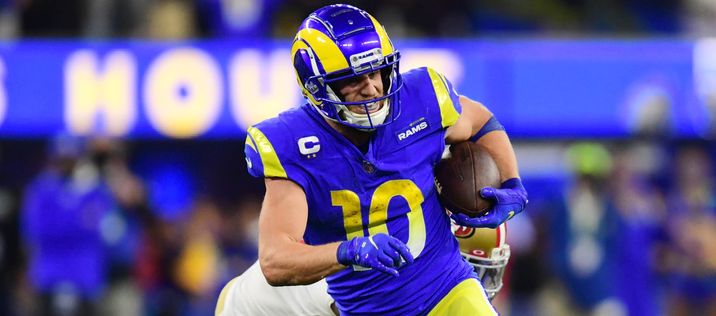
What can we say about Cooper Kupp that hasn't already been said? His 191 targets led the league and ranks ninth all-time. He had a ridiculous 14 games with 10+ targets. His 2021 season is one of only two in history that includes 100+ receptions, 1,500+ yards, and 15+ touchdowns (Randy Moss is the other - that's rarified air). Just to prove he isn't a possession receiver, he had the most yards after the catch and second most completed air yards of any receiver in football. Kupp also had the catch of the season for the Rams in their victory over the Bucs in the Divisional Round. Simply put, without him, the Rams offense would be mediocre. You can miss me with all the Matt Stafford (QB - LAR) talk there too.
As for their ancillary pieces, Robert Woods (WR - LAR) tore his ACL in Week 9 which opened up targets for Van Jefferson (WR - LAR). Jefferson almost tripled his 2020 target count, finishing with 89 for the season. He turned that into 802 yards and six touchdowns, finishing seventh in yards per reception and 11th in aDOT. His production could eventually make Woods expendable as the Rams will be up against the cap in the next couple of seasons.
The 2021 Las Vegas Raiders were a beautiful mess that made it to the playoffs and put a scare into Cincinnati with a skeleton crew at receiver. Two big things from this year's Las Vegas team stick out and are part of the reason they were middling offensively. Hunter Renfrow (WR - LV) was their leading receiver, finishing as a WR2 with 128 targets. His aDOT was 6.6, which ranked 101st at the position, so without the massive volume, he has more of a W3/WR4 profile.
The other stat with Las Vegas that sticks out is Darren Waller's (TE - LV) 93 targets, second on the team despite missing six games. We could probably take a deep dive into Waller's season and make it a standalone piece. His TE6 finish was a combination of a couple big games mixed with mediocre production at the position league-wide. He started off with a big Week 1, getting a whopping 19 targets, but only had a total of 21 over his next three games. That was a harbinger of things to come, as Waller only had two more games with 10+ targets the rest of the season. I think we have to be encouraged by the 12 targets he had in the Wild Card game and I look for him to get back to his top-5 TE type season next year. He could be a nice value in drafts as he will be undervalued coming off a seemingly underwhelming 2021.
Miami had one of the more narrow distribution target shares in the league, as the four players listed above accounted for 60% of their targets. Jaylen Waddle getting 142 targets - 10th among receivers and tops among rookies - was a surprise but contributed to his WR15 finish. Waddle wasn't considered a volume guy coming out of Alabama, but he posted six games of 10+ targets and eight games with 7+ receptions. His aDOT of 6.3 is a bit concerning but if there is an area of growth for him, this is it. Waddle should be a solid WR2 next year with upside for more - we just have to hope he doesn't turn into Jarvis Landry.
Mike Gesicki got plenty of volume (111 targets ranked 4th among tight ends) and air yards (1,101 ranked 3rd) but failed to average 10 fantasy points per game. Gesicki was a victim of touchdown regression, as he took a backseat to Waddle when in the Red Zone. He did set career highs in catches (73) and yards (780), so as he enters free agency, where he lands will have a big effect on his stock for next year. A return to the Dolphins might not be the worst thing, but going to a team like the Chargers - who have the cap money and the need - might help him capitalize on some of the unrealized air yards.
Jakobi Meyers had a quasi-breakout season, finishing in the top-20 of receivers in receptions (83), target share (23.6%), and targets (126). The issue here is that he finished as the WR38 in fantasy scoring so despite getting the volume of a fantasy WR2, he couldn't turn that into enough production to be a weekly starter. Part of the problem can be attributed to a historically bad touchdown rate. He scored just two touchdowns this season and, somewhat remarkably, those are the only two touchdowns he has in his three-year career. I think there is a lot of upside with Meyers and he is probably flying a bit under the radar despite having a good year from a volume standpoint. If I was going to invest in the Patriots heading into 2022, he'd be the piece I'd want.
The ancillary guys here have some intrigue, but my worry is the Patriots don't support enough passing volume to be in love with any singular piece. I like Kendrick Bourne (WR - NE) as a player and he was super efficient this year, finishing second in the NFL with 2.58 points per target. To put his year in perspective as a contrast to Meyers, he finished as the WR40 on 56 less targets. He could potentially pop next year but will need more volume. Hunter Henry (TE - NE) scored in bunches (nine touchdowns was 2nd among tight ends) but his weekly volume made him a scoring-dependent dart throw. The Patriots will look different next season with Josh McDaniels leaving for Las Vegas, so we will have to see what happens here next year before we go crazy.
New Orleans wasn't much for fantasy production this year in the passing game, which was to be expected with Drew Brees' retirement. Still, they didn't have a single receiver with 100+ targets or 1,000 yards. Even Alvin Kamara (RB - NO), who has averaged over 100 targets in his career, finished with career lows in targets (67) and receptions (47). Kamara did his work primarily on the ground, finishing with a whopping 240 carries, so that is something to monitor moving forward. Sean Payton is gone, Michael Thomas (WR - NO) might be gone, and the quarterback position is still in limbo, so New Orleans has gone from fantasy wonderland to fantasy wasteland in short order.
I can keep this one short and just say the Giants were a disaster offensively in 2021. They go out and sign Kenny Golladay (WR - NYG) to a big contract and he was a major disappointment, finishing as the WR83. He has a $21 million cap number for 2022, so he's locked into their short-term plans for that reason alone. I like Sterling Shepard (WR - NYG), but he's been used mostly underneath as a possession receiver. He will need to get close to 100 targets to flourish next season, which might not be out of the question if Brian Daboll has Daniel Jones (QB - NYG) throwing the ball with the same volume he had Josh Allen throwing it. The other receiver worth mentioning is Kadarius Toney (WR - NYG), but it is hard to say where he will fit in. He popped in limited action this year with a couple big games. A lot of this, once again, hinges on Daboll's ability to help Daniel Jones become a solid NFL quarterback. In any event, there are some weapons here.
There isn't much to discuss here aside from Elijah Moore (WR - NYJ). He finished as the WR30 in points per game and 20th at the position in touchdowns despite only playing 11 games. Moore took a while to get going but by Week 8, he was the Jets' top option in the passing game. He hauled in 34 passes on 51 targets over his last six games, good for 459 yards. I think even if Zach Wilson (QB - NYJ) doesn't figure it out, Moore will be a stud. The other piece of this offense I like is Michael Carter (RB - NYJ). His 55 targets ranked 15th among running backs and this is despite him missing three games and not being involved in the offense as a regular until Week 5. He should be, at worst, an RB2 next year.
The Eagles were No. 2 in the NFL in rush attempts in 2021, so there wasn't a lot of passing volume to go around. That DeVonta Smith (WR - PHI) still saw 104 targets speaks to him being able to improve on his WR39 finish. What is even more encouraging is his aDOT of 14.4, which ranked fifth among wide receivers. Smith somewhat quietly should be on your radar as a buy-low target heading into next season. Dallas Goedert (TE - PHI) finished as the TE8 and set a career high with 830 receiving yards. His 76 targets only ranked 17th among all tight ends, so there is a strong argument to made for him to be a top-5 tight end next year. While the Eagles don't support a lot of volume, their narrow target distribution is a good thing for Smith and Goedert's fantasy outlook.
Diontae Johnson (WR - PIT) turned into the receiver that most people believed JuJu Smith-Schuster (WR - PIT) would be. He finished as the WR8, drawing a career-high 169 targets that ranked second among receivers. He also ran the most routes of any receiver in football, so while his aDOT of 8.4 wasn't great, he thrived on massive volume, finishing with 107 receptions. Like all of the weapons in Pittsburgh, Johnson's future success will hinge on who the Steelers bring in as quarterback. Chase Claypool (WR - PIT) had a somewhat disappointing 2021, finishing with nearly identical numbers as his 2020 rookie year. Claypool can be maddeningly inconsistent and he seems to be a bad fit for Pittsburgh's short passing game.
Najee Harris (RB - PIT) was as good as advertised, finishing as the RB6. He led all running backs in targets (94), receptions (74), and routes run. The concern with Harris is his 380+ touches this year. Historically, most running backs with that kind of workload don't last long. Pat Freiermuth (TE - PIT) got off to a slow start, but beginning in Week 6, he was a weekly TE1. Freiermuth is not a vertical threat but he has big time scoring potential, as he ranked first among all tight ends with 20 Red Zone targets. As I mentioned, a lot here will depend on the quarterback situation in Pittsburgh but with the right guy, this offense could soar.
The Seahawks had two receivers who accounted for nearly 50% of their targets this year, joining the Ravens as one of two teams with such a distinction. D.K. Metcalf (WR - SEA) was a disappointment despite getting a 26.1% target share. He had fewer receptions and yards this year, finishing as the overall WR22. Metcalf ranked first at the position in unrealized air yards, which illustrates just how much meat he left on the bone. If Russell Wilson (QB - SEA) is back in 2022, I like him to bounce back. Tyler Lockett (WR - SEA) went through a transformation coming off a sterling 2020 season where he had 100 receptions and finished as the WR12. Lockett was more of a downfield threat this year, finishing with 1,175 receiving yards (8th at the position) and was 7th in aDOT, but had just 73 receptions. His 107 targets was also fewer than the 132 he had in 2020. For Lockett to finish as a WR1, he will need to get back to 90+ receptions - no sure thing in this offense.
Deebo Samuel (WR - SF) is a beast. He finished the season as the WR3, partially on the back of 59 carries for 365 yards. But Samuel was more than just a Swiss army knife for the 49ers. His 1,405 yards were good for fifth among all receivers and his target share was sixth. Where he truly excelled was after the catch, as his 777 YAC yards ranked second at the position. With the ball in his hands, Samuel was arguably the best football player in the league.
George Kittle (TE - SF) bounced back this year from an injury-plagued 2020 season. He finished as the TE4 in points per game and 94 targets ranked seventh at the position as Kittle re-established himself as one of the premier players at the position. The 49ers will likely remain one of the most run-heavy teams in the league - especially with Trey Lance (QB - SF) taking over next year - so the distribution of targets will remain narrow. Because of this, Brandon Aiyuk (WR - SF) will have some weeks where he pops, but more often than not he will be a distant third option.
I listed eight Buccaneers here just to show how deep their receiving corps went this year. Tampa Bay was the most pass-heavy unit in the NFL and had Tom Brady running the show, so this comes as no surprise. There are a lot of questions heading into the offseason here and this team is likely to look much different next September. Chris Godwin (WR - TB) and his 127 targets are eligible for free agency. Antonio Brown (WR - FA) might be done with football altogether after he left a game against the Jets in the 2nd quarter. I highly doubt Rob Gronkowski (TE - TB) is back with Brady retiring. So there are 277 targets potentially up for grabs heading into next season.
The caveat here is Brady's retirement looms large over the Buccaneers' offense. Even so, Mike Evans (WR - TB) has had eight consecutive seasons with 1,000 yards and 100+ targets. Assuming Godwin isn't back, Evans should be in a strong position to keep that streak going. The other piece I am interested in here is Tyler Johnson (WR - TB), who is one of the better buy-low candidates in dynasty leagues. Without doing much other than showing up this spring, Johnson could find himself in a position to see a major bump from his 55 targets in 2021.
I don't know how the Titans managed to get the No. 1 seed given all their injuries this year. The receiving corps wasn't immune to that, as A.J. Brown (WR - TEN) missed four games and Julio Jones (WR - TEN) missed seven. Jones hasn't played a full season since 2019, but his cap number for the next two years is in excess of $14 million per season. He will be part of the Titans plans moving forward but I think his best days are behind him. Fortunately, A.J. Brown is a bonafide WR1 who was on his way to setting career highs in every meaningful category before an injury cost him time. Despite playing just 13 games this year, he had seven occasions where he had nine or more targets and his 105 total targets were just one shy of his 2020 total. The Titans should feed Brown 150+ targets next year and if they do, he will be a top-5 wide receiver.
For the second straight year, Terry McLaurin (WR - WAS) got fed like a WR1 - his 131 targets ranked 13th in the league - but his production didn't mirror that volume. He finished as the WR31 with 12.6 fantasy points per game, finishing with fewer receptions and yards than he did in 2020. McLaurin, like D.K. Metcalf, was plagued by horrible inefficiency, finishing third in unrealized air yards. As long as the volume remains, he should be a good bet for a bounce back but he would benefit greatly from an upgrade at quarterback.
J.D. McKissic (RB - WAS) siphoned 53 targets this year, most of which should have went to Antonio Gibson (RB - WAS). Beginning in Week 10, Gibson had a six-game stretch where Washington gave him an RB1 workload and he had weekly finishes of RB7, RB27, RB5, RB6, RB43, and RB4. The two weeks where he finished outside of the top-10, he had a total of two targets. See the correlation here? I do too. I don't understand why NFL teams don't get the ball in the hands of their best players. It seems like a simple enough concept. I'm back in on Gibson next year, as I think he will continue to bump his passing game usage.
Get a FREE 6 month upgrade with our special offer
Subscribe: Apple Podcasts | Spotify | Google Podcasts | Stitcher | SoundCloud | iHeartRadio
Jason Kamlowsky is a featured writer at FantasyPros. For more from Jason, check out his archive and follow him on Twitter @JasonKamlowsky.